 15 min read
The ultimate 2026 guide to effortless healthy eating with weekly meal prep
 Equipo TriwellFebruary 27, 202615 min
<p>How many times have you come home after an exhausting day and ended up ordering fast food because you had nothing prepared? If the answer is "too many," you’re not alone. According to a study published in the <em>International Journal of Behavioral Nutrition and Physical Activity</em>, <strong>people who plan their meals are 64% more likely to maintain a balanced diet</strong> than those who just wing it every day.</p>
<p>This is where <strong>meal prep</strong>—or weekly meal preparation—comes in, a strategy that’s revolutionizing how we eat. And no, it’s not about spending your entire Sunday locked in the kitchen. It’s about being smart with your time so eating well becomes the easiest thing in the world.</p>
<h2>What Exactly Is Meal Prep?</h2>
<p>Meal prep means <strong>dedicating a block of time (usually 2-3 hours) to prepare, cook, and store your meals for several days</strong>. It can range from prepping basic ingredients (chopping vegetables, cooking proteins) to having entire ready-to-go containers that you simply heat and eat.</p>
<p>There’s no single way to do it. In fact, there are several approaches:</p>
<ul> <li><strong>Full batch cooking:</strong> You cook entire dishes and store them in individual servings.</li> <li><strong>Ingredient prepping:</strong> You get components ready (cooked rice, grilled chicken, chopped veggies) and combine them as you go.</li> <li><strong>Hybrid method:</strong> You prepare some full dishes and other stand-alone ingredients for flexibility.</li> <li><strong>Strategic freezing:</strong> You cook double and freeze half for future weeks.</li> </ul>
<h2>The Science-Backed Benefits of Meal Prep</h2>
<p>Beyond convenience, scientific evidence strongly supports this practice:</p>
<h3>1. Improves the quality of your diet</h3>
<p>A 2017 study published in the <em>American Journal of Preventive Medicine</em> found that those who spend more time cooking at home consume <strong>significantly fewer calories, less sugar, and less saturated fat</strong> than those who eat out frequently. Meal prep kills the need to improvise—which is when we tend to make the worst food choices.</p>
<h3>2. Saves you money (a lot)</h3>
<p>Planning reduces food waste, which according to the FAO represents <strong>a third of all food produced globally</strong>. When you shop with a list and cook with a plan, every ingredient has a purpose. Studies estimate that an average family can save between <strong>€200-300 per month</strong> just by planning their meals.</p>
<h3>3. Reduces daily stress</h3>
<p>"Decision fatigue" is a real psychological phenomenon. Each day, we make more than 200 food-related decisions. Meal prep eliminates most of them. Researchers at Cornell University found that <strong>cutting down on daily food choices significantly reduces cortisol levels</strong> (the stress hormone) associated with mealtime.</p>
<h3>4. Natural portion control</h3>
<p>When you prepare your meals ahead of time, you automatically control portions. A meta-analysis published in the <em>Cochrane Database of Systematic Reviews</em> showed that <strong>predefined portions cut calorie intake by 12%-16%</strong> without feeling restricted.</p>
<h3>5. More free time during the week</h3>
<p>It might sound contradictory to spend 2-3 hours on Sunday to gain more time, but the math doesn’t lie. If cooking daily takes you 45 minutes, that’s <strong>5.25 hours a week</strong> just on weekday dinners. With meal prep, you cut that to less than 1 hour total (heating and assembling). That’s over 4 hours back each week.</p>
<h2>Step-by-Step Guide: Your First Meal Prep</h2>
<h3>Step 1: Plan your weekly menu</h3>
<p>Before setting foot in the grocery store, you need a plan. Here’s a structure that works:</p>
<ul> <li><strong>Pick 2-3 proteins:</strong> Chicken, salmon, legumes, eggs, tofu…</li> <li><strong>Pick 2-3 complex carbs:</strong> Brown rice, quinoa, sweet potato, whole wheat pasta…</li> <li><strong>Pick 4-5 veggies:</strong> Broccoli, spinach, bell peppers, carrots, zucchini…</li> <li><strong>Pick 2-3 healthy fats:</strong> Avocado, nuts, extra virgin olive oil…</li> <li><strong>Add variety with sauces and spices:</strong> Hummus, pesto, soy sauce, various spices…</li> </ul>
<p><strong>Triwell Tip:</strong> The key is variety within simplicity. You don’t need 15 different recipes. With 4-5 combos, you can cover the whole week without getting bored.</p>
<h3>Step 2: Make your shopping list</h3>
<p>With your menu set, make your list organized by grocery store sections (produce, proteins, grains, etc.). This cuts down shopping time and avoids impulse buys. A study from the University of Pennsylvania showed that <strong>shopping with a list reduces spending by 23%</strong> and improves the nutritional quality of your grocery basket.</p>
<h3>Step 3: Organize your cooking session</h3>
<p>Order matters. Follow this sequence to maximize efficiency:</p>
<ol> <li><strong>First:</strong> Preheat the oven and start boiling water. What takes longest, goes first.</li> <li><strong>Second:</strong> While the oven heats, wash and chop all your veggies.</li> <li><strong>Third:</strong> Oven-roast the veggies and proteins that need it.</li> <li><strong>Fourth:</strong> Cook grains (rice, quinoa) and legumes on the stove.</li> <li><strong>Fifth:</strong> While everything’s cooking, whip up sauces, dressings, and snacks.</li> <li><strong>Sixth:</strong> Let cool before storing in containers.</li> </ol>
<p><strong>Estimated time:</strong> 2-3 hours to prep 15-20 meals. With practice, you’ll cut it to under 2 hours.</p>
<h3>Step 4: Smart storage</h3>
<p>Storage is where many people stumble. Here are the golden rules:</p>
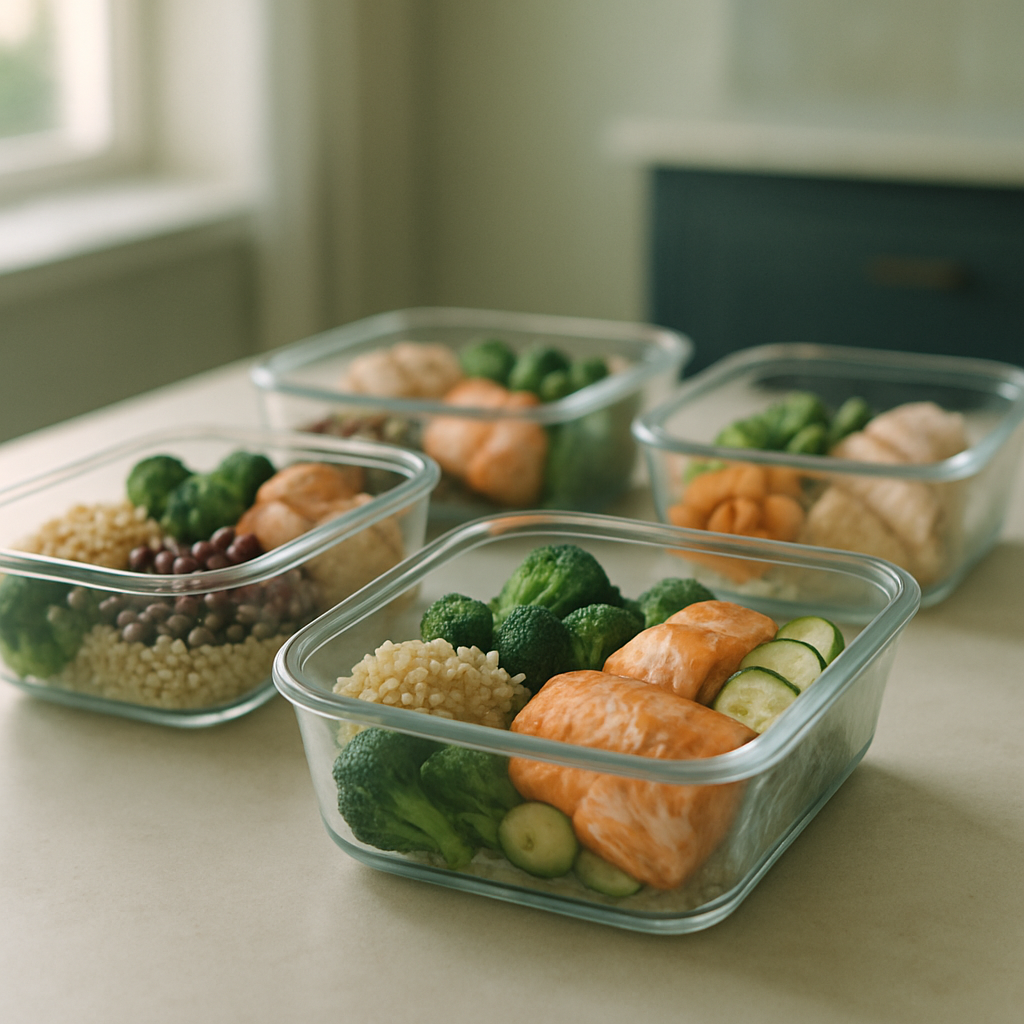
<ul> <li><strong>Glass containers > plastic:</strong> They don’t transfer flavors, are more hygienic, and are microwave-safe.</li> <li><strong>Label everything:</strong> Prep date and contents. It feels over the top, but it makes a difference.</li> <li><strong>In the fridge:</strong> Prepped meals last 3-4 days in good condition.</li> <li><strong>Freeze Thursday-Friday meals:</strong> If you prep on Sunday, freeze the Thursday and Friday meals so they’ll be perfect when you need them.</li> <li><strong>Separate sauces:</strong> Store them apart so ingredients don’t get soggy.</li> </ul>
<h2>Sample Menu: Your First Week of Meal Prep</h2>
<p>Here’s a balanced, easy-to-prepare weekly menu:</p>
<h3>Main proteins</h3> <ul> <li>1 kg oven-baked chicken breast with spices</li> <li>500g oven-baked salmon with lemon</li> <li>1 large can of cooked chickpeas</li> </ul>
<h3>Main carbs</h3> <ul> <li>Brown rice (for 5 servings)</li> <li>Quinoa (for 3 servings)</li> <li>2 roasted sweet potatoes</li> </ul>
<h3>Main veggies</h3> <ul> <li>Steamed broccoli</li> <li>Oven-roasted peppers and onion</li> <li>Fresh spinach</li> <li>Grated carrots</li> </ul>
<h3>Weekly combos</h3> <ul> <li><strong>Monday:</strong> Chicken bowl + brown rice + broccoli + soy sauce</li> <li><strong>Tuesday:</strong> Salmon + quinoa + roasted peppers + lemon</li> <li><strong>Wednesday:</strong> Chickpea salad + spinach + carrot + hummus</li> <li><strong>Thursday:</strong> Chicken + sweet potato + roasted veggies + pesto (defrost)</li> <li><strong>Friday:</strong> Salmon bowl + rice + spinach + avocado (defrost)</li> </ul>
<h2>Common Meal Prep Mistakes (and How to Avoid Them)</h2>
<h3>❌ Mistake 1: Being too ambitious at first</h3> <p>Don’t try to prep 21 gourmet meals your first week. Start with 5 meals (weekday lunches) and expand once you’re comfortable.</p>
<h3>❌ Mistake 2: Not considering texture</h3> <p>Some foods don’t hold up well in the fridge for several days. Avoid prepping ahead: dressed salads, pasta already mixed with sauce, or fried foods. The texture changes completely.</p>
<h3>❌ Mistake 3: Forgetting snacks</h3> <p>80% of “diet slip-ups” happen between meals. Prep snacks, too: small bags of nuts, hummus with veggie sticks, cut-up fruit, or homemade oat bars.</p>
<h3>❌ Mistake 4: Not varying the spices</h3> <p>The same chicken and rice can taste totally different with curry, za’atar, chimichurri, or teriyaki sauce. <strong>Spices are your secret weapon against boredom.</strong></p>
<h3>❌ Mistake 5: Forgetting breakfast</h3> <p>Breakfast is the easiest meal to prep ahead: <em>overnight oats</em>, freezable egg muffins, smoothie packs (bags of frozen fruit ready to blend). Investing 10 extra minutes in breakfast can transform your morning.</p>
<h2>Meal Prep and Specific Goals</h2>
<h3>For weight loss</h3> <p>Meal prep is one of the most effective tools for weight loss because it eliminates improvisation. Researchers at Cambridge University found that <strong>people who plan meals have a significantly lower BMI</strong> and a more varied diet. The key: prep controlled portions and focus on veggies and proteins over refined carbs.</p>
<h3>For muscle gain</h3> <p>If your goal is hypertrophy, meal prep ensures you meet your daily protein needs (1.6-2.2g per kg of bodyweight, according to the <em>International Society of Sports Nutrition</em>). Prep servings with at least 30g of protein per meal and spread your intake throughout the day.</p>
<h3>For more energy</h3> <p>Eating irregularly causes glucose spikes and crashes that drain your energy. Meal prep lets you maintain a regular pattern with balanced meals that stabilize blood sugar. Always include fiber, protein, and healthy fats in each meal for sustained energy release.</p>
<h2>Tools That Make Meal Prep Easier</h2>
<p>You don’t need a professional kitchen. These basic tools make a huge difference:</p>
<ul> <li><strong>Glass containers with compartments:</strong> Allow you to keep ingredients separate in the same box.</li> <li><strong>Large oven tray:</strong> To roast veggies and proteins at the same time (<em>sheet pan cooking</em> is your best friend).</li> <li><strong>Rice cooker or programmable pot:</strong> Cook grains and legumes hands-free while you prep the rest.</li> <li><strong>Reusable silicone bags:</strong> For freezing single servings sustainably.</li> <li><strong>Label maker or masking tape:</strong> To note down dates and contents.</li> </ul>
<h2>Meal Prep and Artificial Intelligence: The Future of Planning</h2>
<p>Technology is transforming meal prep. Apps like Triwell use artificial intelligence to:</p>
<ul> <li><strong>Generate personalized menus</strong> based on your goals, preferences, and dietary restrictions.</li> <li><strong>Create optimized shopping lists</strong> that minimize waste and spending.</li> <li><strong>Auto-adjust portions</strong> based on your physical activity and calorie burn.</li> <li><strong>Suggest smart substitutions</strong> when an ingredient isn’t available.</li> <li><strong>Learn from your preferences</strong> to improve recommendations over time.</li> </ul>
<p>The combination of smart planning and AI assistance makes eating well more accessible than ever.</p>
<h2>Meal Prep FAQs</h2>
<h3>How long does prepped food last in the fridge?</h3> <p>As a rule of thumb, <strong>3-4 days in the fridge</strong> and <strong>2-3 months in the freezer</strong>. Meals with eggs or seafood last less (2 days in the fridge). Always trust your nose: if something smells off, toss it.</p>
<h3>Isn’t some freshness lost?</h3> <p>Some texture is lost—it’s inevitable. But here are some tricks: don’t mix wet and dry ingredients until mealtime, store sauces separately, and keep crunchy toppings (nuts, seeds) to add just before eating.</p>
<h3>Are nutrients lost when reheating?</h3> <p>Nutrient loss is minimal. According to the <em>Harvard T.H. Chan School of Public Health</em>, reheating food does not significantly destroy nutrients. The important part is to not overheat: use medium microwave power and heat just until pleasantly warm.</p>
<h3>How much does it cost to start?</h3> <p>The initial investment in good containers is about €30-50. From there, meal prep <strong>saves you money</strong> week after week. A well-planned weekly shop for one person can run €30-50, covering all main meals.</p>
<h2>Your Action Plan: Start This Sunday</h2>
<p>You don’t need to wait for the perfect moment. Here’s your starter plan:</p>
<ol> <li><strong>This Friday:</strong> Choose 3 proteins, 2 carbs, and 4 veggies.</li> <li><strong>This Saturday:</strong> Shop with your list (don’t go hungry).</li> <li><strong>This Sunday:</strong> Spend 2.5 hours on your first meal prep session.</li> <li><strong>Monday to Friday:</strong> Enjoy homemade, healthy meals with zero effort.</li> <li><strong>Next Sunday:</strong> Repeat, tweaking what didn’t work.</li> </ol>
<p>Meal prep isn’t a diet, a fad, or something that has to be perfect. It’s simply <strong>a smarter way to fuel yourself</strong>. And like any habit, it gets easier with practice.</p>
<p>At Triwell, we believe wellness shouldn’t be complicated. Sometimes, the most transformative thing is the simplest: setting aside a couple of hours a week so eating well stops being a problem and becomes your edge.</p>
<p><strong>Ready for your first meal prep? Your body (and your calendar) will thank you. 💚</strong></p>