 9 min read
Stretching exercises for back pain at the office
 Equipo TriwellFebruary 26, 20269 min
If you spend more than six hours a day sitting in front of a computer, your back has already sent you a warning. Maybe it’s that tension between your shoulder blades that creeps in by mid-morning, or that twinge in your lower back that greets you every time you get up from your chair. You’re not alone: according to data from the European Agency for Safety and Health at Work, musculoskeletal disorders affect nearly 60% of European workers, and back pain tops the list.
What’s interesting is that the solution doesn’t require joining a gym or buying expensive equipment. With a stretching routine of barely 10 minutes that you can do right next to your desk, you’ll notice a real difference. I’ve spent years recommending these sequences to my office colleagues, and those who stick with them all say the same thing: they wish they’d started sooner.
Let’s go through the 10 stretches that work best, explained step by step.
1. Neck Rotation
Start with the basics. Sitting with your back straight, let your right ear fall toward your right shoulder. Hold for 15 seconds, then switch sides. Don’t force it: the weight of your head is enough to feel the stretch. Repeat 3 times per side.
This movement releases tension in the upper trapezius, that muscle that turns to stone after hours of staring at a screen. A study published in the Journal of Physical Therapy Science showed that cervical stretches done every 2 hours significantly reduce neck pain in office workers.
2. Chin Tuck
Sit up straight and pull your chin back, as if you’re deliberately making a double chin. Hold for 5 seconds, then release. Do 10 repetitions.
It looks ridiculous, I know. But this exercise corrects “forward head” posture, which we all fall into unknowingly while looking at a computer. Over time, that posture overloads the cervical spine and creates pain that radiates into the upper back.
3. Chest Stretch in the Doorway
Stand up for this one. Place your forearms in a doorway, elbows at shoulder height, and step forward. You’ll feel your chest open up. Hold for 20 seconds.
Why stretch the chest in a back routine? Because when the pectorals become shortened—which often happens when you type all day—they pull the shoulders forward, forcing your back muscles to work overtime to compensate. It’s a chain: short chest, overloaded back.
4. Seated Spinal Twist
While sitting in your chair, cross your right leg over your left. Place your left hand on your right knee and twist your torso to the right, using the back of your chair for support. Hold for 20 seconds, then switch sides.
This stretch mobilizes the entire thoracic and lumbar spine. After hours in the same position, your spine needs a reminder that it can rotate. The relief is almost immediate: many people feel a gentle “crack” in the back, a sign that the joints were compressed.
5. Chair Cat-Cow
Sit on the edge of your chair with your feet on the floor, hands on your knees. As you inhale, arch your back by pushing your chest forward and looking up. As you exhale, round your back and tuck your chin toward your chest. Alternate for 30 seconds.
This classic yoga move works just as well while seated. It alternates flexion and extension of the spine, lubricates the intervertebral discs, and activates deep stabilizing muscles. It’s probably the highest benefit-to-effort stretch on the whole list.
6. Piriformis Stretch (Figure 4)
While sitting, place your right ankle over your left knee to form a "4." Lean your torso slightly forward, keeping your back straight. Hold for 20 seconds per side.
The piriformis is a deep hip muscle, and when it’s tight, it can compress the sciatic nerve causing pain that radiates into the lower back and down the leg. Hours of sitting shortens it. This stretch directly counteracts that.
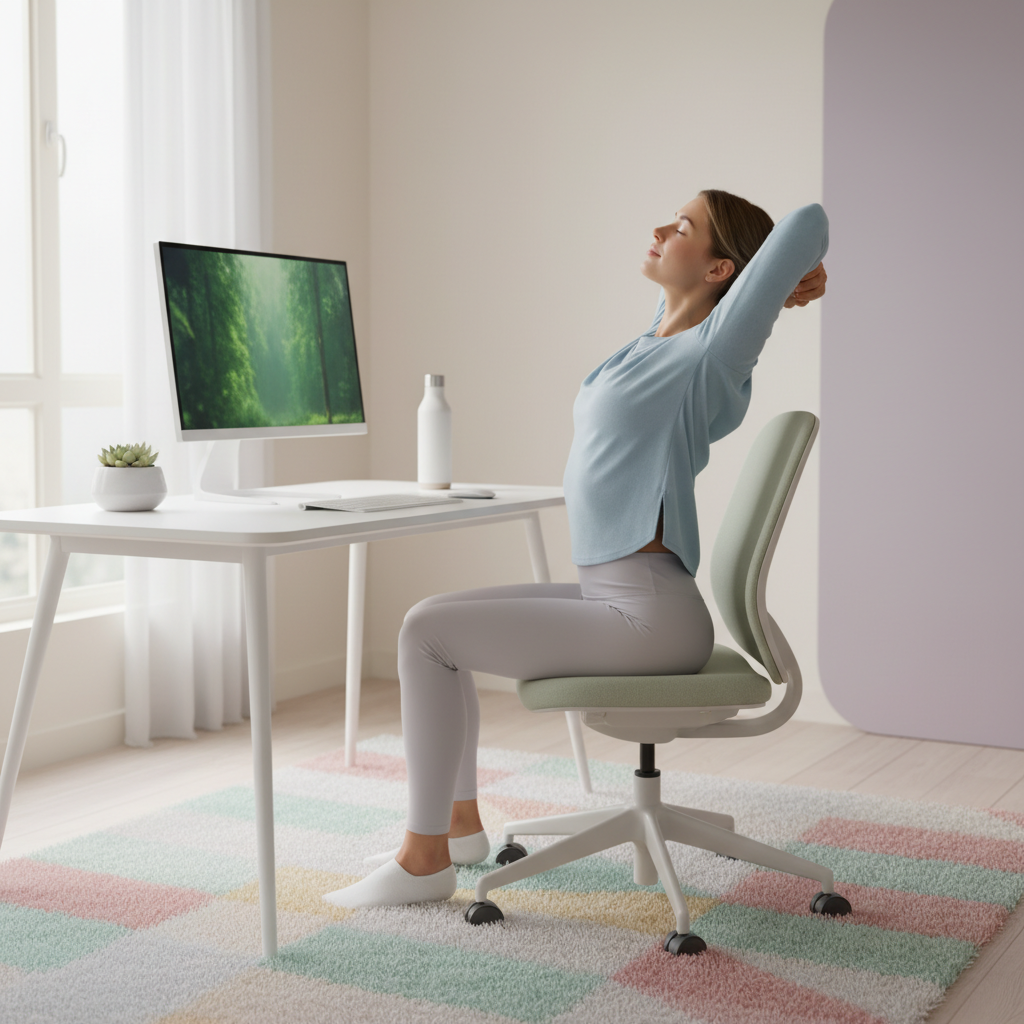
7. Back Extension in the Chair
Place your hands behind your neck and spread your elbows wide. From here, arch your upper back over the backrest of your chair. Hold for 10 seconds and repeat 5 times.
Here we’re working on thoracic extension, the opposite of slouching. If your chair has a firm backrest, the effect is almost like a foam roller. This is essential for those who feel stiffness in the middle back.
8. Hip Flexor Stretch
Stand next to your chair. Take a long step back with your right foot and slightly lower your hips, keeping your torso upright. You’ll feel a stretch in the front of your right hip. Hold for 20 seconds and switch.
Shortened hip flexors are the silent culprit behind a lot of lower back pain. When you sit for hours, these muscles adapt to the shortened position. When you stand up, they pull your pelvis forward, increasing the curve in your lower back and compressing the vertebrae. Regularly stretching them is one of the best things you can do for your lower back.
9. Seated Hamstring Stretch
Sit on the edge of your chair and stretch one leg out in front, heel on the floor. Keeping your back straight, hinge forward from your hips toward the outstretched leg. Hold for 20 seconds per leg.
Hamstrings work together with your lower back. When they’re tight, they limit pelvis mobility and force your lumbar spine to compensate every time you bend over. According to the Mayo Clinic, regularly stretching your hamstrings is a basic recommendation for anyone with lower back pain.
10. Shoulder Shrug and Retraction
Lift your shoulders to your ears with force and hold for 5 seconds. Drop them suddenly. Repeat 5 times. Then, squeeze your shoulder blades together as if you were trying to hold a pencil between them. Hold for 10 seconds, repeat 5 times.
This double exercise first releases tension in the trapezius, then activates the rhomboids and middle trapezius, muscles that “fall asleep” in office posture. It’s the perfect finish for the routine.
How to Organize Your Daily Routine
You don’t have to do all 10 at once. What works best is to divide them into two blocks:
In the morning (5 minutes): Exercises 1, 2, 3, 5, and 10. These wake up the upper back and correct your posture from the start of the day.
After lunch (5 minutes): Exercises 4, 6, 7, 8, and 9. These focus more on your lower back and hips, where the morning’s tension builds up.
If you can only do one block, pick the after-lunch one. Research from Gottraining, based on a protocol published in the journal Work, showed that even three weekly office exercise sessions significantly reduce back pain.
A Couple of Common Mistakes
Forcing the stretch. If it hurts, you’re going too far. The stretch should be noticeable, not painful. Always work within a comfortable range and let flexibility come with time.
Only stretching when it hurts. Stretches work better as prevention than as a treatment. Once pain sets in, it’s harder to reverse it with stretching alone. The key is daily consistency, even when you feel fine.
Poor breathing. Every stretch should be accompanied by slow, deep breaths. Shallow breathing tenses the muscles instead of relaxing them. Inhale through your nose, exhale through your mouth, and use each exhale to deepen the stretch a little more.
When to See a Professional
These stretches are safe for most people, but there are warning signs you shouldn’t ignore. If the pain radiates down your leg, if you feel tingling or weakness in your limbs, or if the pain lasts more than two weeks without improvement, see a physical therapist or doctor. Chronic back pain can have causes that require professional diagnosis, like herniated discs or spinal stenosis.
The bottom line is simple: your body wasn’t designed to spend 8 hours in the same position. But since changing jobs isn’t always an option, adapting your daily routine with these stretches is the most practical and effective way to keep your back healthy. Ten minutes a day. No excuses, no equipment, barely leaving your chair. Your back will thank you.