 17 min read
Science-backed strength training for beginners: The complete guide
 Equipo TriwellApril 13, 202617 min
<article> <p>Have you ever wanted to start weight training but didn’t know where to begin? Maybe the machines at the gym intimidate you, or you feel like “that’s for people who are already in shape.” Well: strength training is exactly for you, especially if you’re a beginner.</p>
<p>The science is clear: <strong>strength training is one of the most powerful health interventions that exist</strong>, with benefits ranging from body composition to mental health, and longevity. Best of all, you don’t need to be an athlete, have expensive equipment, or dedicate hours a day to start seeing results.</p>
<p>In this complete guide, evidence-based and designed for those starting from zero, you’ll find everything you need: why to do it, how to do it, how often, and a 4-week routine you can start today.</p>
<h2>Why Strength Train? What the Science Says</h2>
<p>Before talking routines and sets, it’s worth understanding <em>why</em> it’s worth investing time in strength training. The data is compelling:</p>
<h3>1. More Muscle = Better Metabolism</h3> <p>Muscle tissue is metabolically active: it burns calories even at rest. A study published in the <em>Journal of Applied Physiology</em> showed that 10 weeks of strength training can increase basal metabolism by 7%, equivalent to burning between 100 and 200 extra calories per day without doing anything additional.</p>
<h3>2. Protection Against Chronic Diseases</h3> <p>According to the <em>American College of Sports Medicine</em>, strength training reduces the risk of cardiovascular disease by 17%, improves insulin sensitivity by up to 46% in people with prediabetes, and decreases markers of chronic inflammation. Basically, it’s preventive medicine in the form of exercise.</p>
<h3>3. Bone Health and Longevity</h3> <p>After age 30, we lose between 3% and 8% of muscle mass per decade (a process known as sarcopenia). Strength training not only slows this loss, but can reverse it. A 2022 meta-analysis in <em>JAMA Internal Medicine</em> with over 100,000 participants found that those who regularly performed strength training had a 10-17% lower risk of all-cause mortality.</p>
<h3>4. Benefits for the Mind</h3> <p>Don’t kid yourself: lifting weights also trains your brain. Strength training increases levels of BDNF (brain-derived neurotrophic factor), improves mood thanks to the release of endorphins and serotonin, reduces symptoms of depression and anxiety, and improves sleep quality. A 2021 review published in <em>Psychological Medicine</em> concluded that strength training is as effective as antidepressants in cases of mild to moderate depression.</p>
<h2>Fundamental Concepts Every Beginner Should Know</h2>
<h3>Progressive Overload: The King Principle</h3> <p>If there’s one concept you should tattoo in your memory, it’s this: <strong>progressive overload</strong>. Your body adapts to the stress you place on it. To keep improving, that stress must gradually increase over time.</p>
<p>This doesn’t mean you have to increase the weight every session. You can progress in various ways:</p> <ul> <li>Increasing the weight lifted</li> <li>Doing more repetitions with the same weight</li> <li>Reducing rest time between sets</li> <li>Improving technique and range of motion</li> <li>Adding more weekly sets</li> </ul>
<h3>Sets, Repetitions and Rests</h3> <p>When you see “3×10” in a routine, it means 3 sets of 10 repetitions. For beginners, science recommends:</p> <ul> <li><strong>Repetitions:</strong> 8-15 per set (hypertrophy and strength range)</li> <li><strong>Sets:</strong> 2-4 per exercise</li> <li><strong>Rest:</strong> 60-120 seconds between sets</li> <li><strong>RPE (perceived exertion):</strong> finish each set able to do 2-3 more reps (don’t go to total failure)</li> </ul>
<h3>Main Muscle Groups</h3> <p>The human body can be divided into major muscle groups. For a balanced routine, you should work them all:</p> <ul> <li><strong>Legs:</strong> quadriceps, hamstrings, glutes, calves</li> <li><strong>Back:</strong> lats, traps, rhomboids, lower back</li> <li><strong>Chest:</strong> pectoralis major and minor</li> <li><strong>Shoulders:</strong> anterior, medial, and posterior deltoids</li> <li><strong>Arms:</strong> biceps, triceps, forearms</li> <li><strong>Core:</strong> abdominals, obliques, transverse abdominis</li> </ul>
<h2>How Often to Train?</h2> <p>One of the most common mistakes is thinking that more is better. For beginners, the evidence points to something different.</p>
<p>A 2019 meta-analysis in the <em>Journal of Strength and Conditioning Research</em> analyzed 25 studies and concluded that training each muscle group 2-3 times per week produces superior results compared to once a week, with no significant difference between 2 and 3 times.</p>
<p><strong>Recommendation for beginners: 3 training days per week with rest days in between.</strong> For example: Monday, Wednesday, and Friday. This allows for muscle recovery (where real growth happens) and easily fits into any schedule.</p>
<h2>Equipment: What You Actually Need</h2> <p>One of the biggest fitness myths is that you need expensive equipment to start. The reality is you can get extraordinary results with practically nothing:</p>
<h3>Option 0: Just Your Body</h3> <p>Bodyweight exercises (squats, push-ups, lunges, planks) are enough for the first 3-6 months of training. Your own weight is more than enough resistance when you're starting.</p>
<h3>Option 1: Basic Home Equipment</h3> <ul> <li>A pair of adjustable dumbbells (€20-40)</li> <li>A resistance band (€5-15)</li> <li>An exercise mat (€15-30)</li> </ul> <p>With this, you have everything you need for a full year of progression.</p>
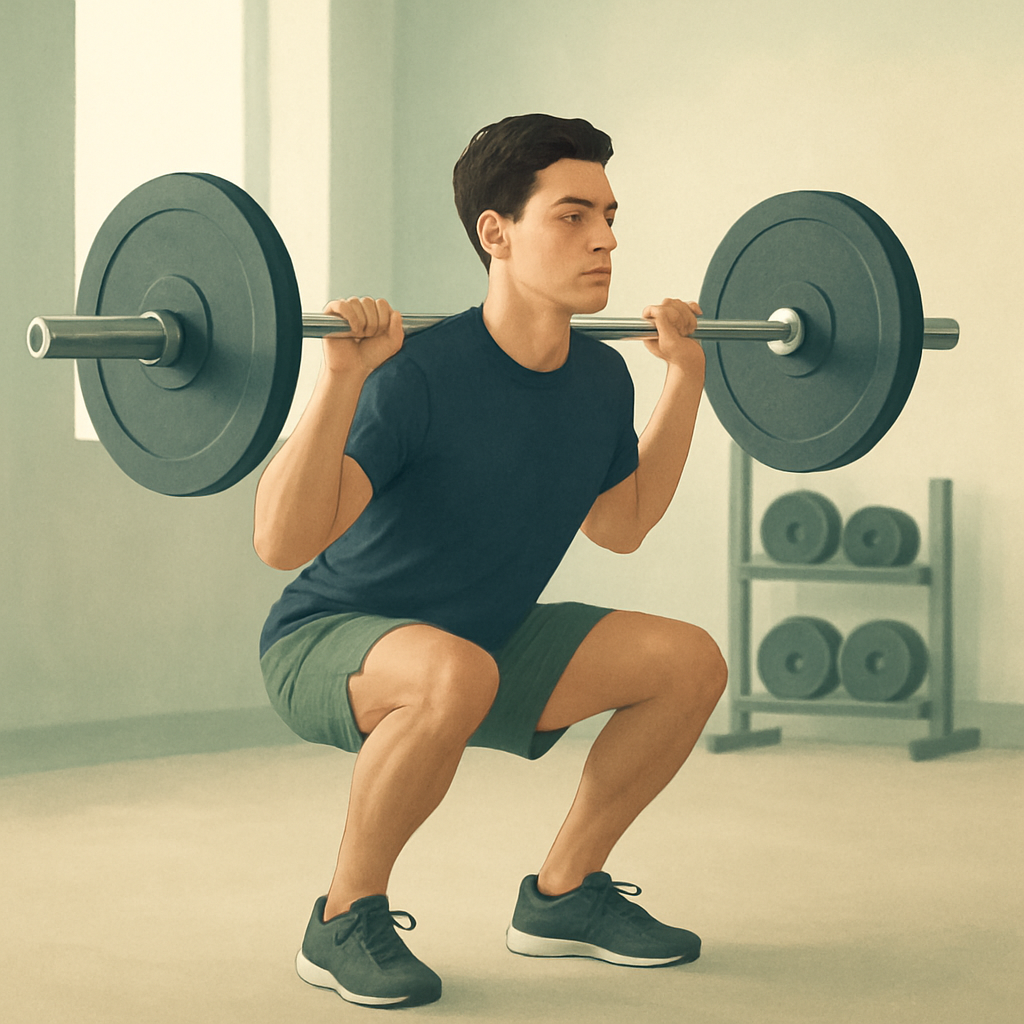
<h3>Option 2: Gym</h3> <p>The gym offers a greater variety of equipment and lets you handle heavier loads as you progress. If you choose the gym, don’t obsess over machines: free-weight exercises (with barbell, dumbbells, or your bodyweight) are more functional and effective for most goals.</p>
<h2>Technique: The Most Important Thing Nobody Teaches You</h2> <p>In strength training, technique is sacred. Poor technique not only reduces results, but exponentially increases injury risk. Here are principles that apply to almost every exercise:</p>
<ul> <li><strong>Neutral spine:</strong> avoid rounding your back. Imagine a board taped to your back.</li> <li><strong>Engaged core:</strong> brace your abs as if you were about to be punched before any movement.</li> <li><strong>Controlled eccentric:</strong> the lowering phase (eccentric) should be slow and controlled (2-3 seconds). This is where most muscle is built.</li> <li><strong>Breathing:</strong> exhale on effort (when you push or lift), inhale on the way down.</li> <li><strong>Full range of motion:</strong> work through the entire available joint range to maximize results.</li> </ul>
<h2>4-Week Routine for Beginners</h2> <p>This routine is designed to be done three days per week (e.g. Monday-Wednesday-Friday) and can be adapted for both the gym and home workouts. It’s a full-body program per session, which science confirms as the most effective for beginners.</p>
<h3>Weeks 1-2: Adaptation Phase</h3> <p><em>Objective: learn the basic movements, activate the neuromuscular system</em></p> <ul> <li><strong>Bodyweight squat:</strong> 3×12 — feet shoulder-width apart, knees tracking toes, hips back and down</li> <li><strong>Push-ups (or knee push-ups):</strong> 3×8-10 — body in straight line, elbows at 45° to your body</li> <li><strong>Dumbbell or band row:</strong> 3×12 — straight back, elbow close to body, scapula retracted at the end</li> <li><strong>Static lunge:</strong> 3×10 per leg — rear knee close to the floor, torso upright</li> <li><strong>Plank:</strong> 3×20-30 sec — straight body, active glutes, don’t let hips sag</li> <li><strong>Shoulder press with dumbbells or band:</strong> 3×12 — push upward without arching the back</li> </ul> <p>Rest between sets: 60-90 seconds. Total session: 35-45 minutes.</p>
<h3>Weeks 3-4: Loading Phase</h3> <p><em>Objective: increase intensity, start progressive overload</em></p> <ul> <li><strong>Dumbbell squat or goblet squat:</strong> 4×10 — add weight compared to previous weeks</li> <li><strong>Push-ups with feet elevated (or regular push-ups if these are too hard):</strong> 3×10-12</li> <li><strong>Bent-over row (both arms):</strong> 4×10 — more weight or greater band resistance</li> <li><strong>Romanian deadlift with dumbbells:</strong> 3×12 — hinge at the hips, flat back</li> <li><strong>Side plank:</strong> 3×20 sec per side</li> <li><strong>Seated shoulder press:</strong> 3×12 — better control and range</li> <li><strong>Biceps curl + triceps extension:</strong> 3×12 each</li> </ul> <p>Rest between sets: 60-90 seconds. Total session: 45-55 minutes.</p>
<h3>Week-to-Week Progression</h3> <p>If you complete all sets and reps with good technique and have “plenty of energy left” (more than 3 reps in reserve), make one of these adjustments in the next session:</p> <ul> <li>Increase the weight by 5-10%</li> <li>Add 1-2 reps per set</li> <li>Reduce rest between sets by 10-15 seconds</li> </ul>
<h2>Nutrition to Support Your Strength Training</h2> <p>Training without proper nutrition is like trying to build a house without cement. You don’t have to follow a complicated diet, but there are three basics that make a huge difference:</p>
<h3>Protein: The Star Nutrient</h3> <p>Protein is the building block of muscle. The current evidence-based recommendations for people doing strength training are <strong>1.6 to 2.2 grams of protein per kilogram of body weight per day</strong>. For a person weighing 70 kg, that’s 112 to 154 grams daily.</p> <p>High quality protein sources: eggs, chicken, turkey, fish, legumes, dairy (Greek yogurt, cottage cheese), tofu, tempeh, and protein powder if you need to supplement.</p>
<h3>Carbohydrates: Your Fuel</h3> <p>Contrary to some diet fads, carbohydrates are essential for performance in strength training. They provide muscle glycogen, which is the main fuel during high-intensity exercise. Don’t cut them—include quality sources (rice, oats, potatoes, fruit, legumes).</p>
<h3>Timing: Does Meal Timing Matter?</h3> <p>A classic sports nutrition study showed that the post-workout “anabolic window” was 30 minutes. Today, we know the body is much more flexible: what matters most is total daily protein intake. That said, having a meal with quality protein within 2 hours before or after your workout is good practice.</p>
<h2>Recovery: Where the Magic Happens</h2> <p>Muscle doesn’t grow during training—it grows during recovery. Exercise creates microtears in muscle fibers, and during rest, the body repairs them and makes them stronger. Ignoring recovery is the most common mistake enthusiastic beginners make.</p>
<h3>Rest Between Sessions</h3> <p>A trained muscle needs 48-72 hours to fully recover. That’s why the 3 days/week schedule is so effective for beginners: it allows enough recovery.</p>
<h3>Sleep: The Overlooked Superpower</h3> <p>Growth hormone (GH) is secreted primarily during deep sleep. A University of Chicago study showed that sleeping 5.5 hours instead of 8.5 hours reduced muscle protein synthesis by 60%. Prioritize 7-9 hours of quality sleep.</p>
<h3>Deload: Light Weeks</h3> <p>Every 4-6 weeks, plan a deload week: reduce total training volume to 50-60%. This lets your nervous system and connective tissues fully recover, preparing you for the next progression phase.</p>
<h2>Common Mistakes to Avoid</h2>
<h3>1. Going Too Fast, Too Soon</h3> <p>Ego in the gym is beginner’s enemy number one. Starting with weights that are too heavy before mastering technique guarantees injuries and mediocre results. Start light, learn the movement, then add weight.</p>
<h3>2. Not Tracking Your Workouts</h3> <p>If you don’t measure it, you can’t improve it. Keep a simple training log (app or notebook) where you write down weights, sets, and reps for every session. Seeing your progress is also one of the most powerful motivators.</p>
<h3>3. Skipping Rest Days</h3> <p>Rest is not laziness. It’s part of the process. Skipping rest out of anxiety or enthusiasm leads to overtraining, chronic fatigue, and higher injury risk.</p>
<h3>4. Obsessing Over the Scale</h3> <p>Muscle weighs more than fat. It’s perfectly possible for your weight to rise slightly in the first few weeks as your body improves its composition. Use progress photos, body measurements, and how you feel as your main metrics.</p>
<h3>5. Ignoring Warm-Ups</h3> <p>5-10 minutes of active warm-up (joint mobility, light cardio) reduces the risk of injury and improves performance. It’s not wasted time—it’s an investment in your athletic longevity.</p>
<h2>The Beginner Mindset: Your Greatest Asset</h2> <p>There’s something experienced lifters envy about beginners: the <strong>newbie gains</strong>. In the first 3-6 months of strength training, your body responds incredibly quickly. You can gain strength and muscle at a rate you’ll never see again. Take advantage of it.</p>
<p>But more important than physical results is the identity you build. Every time you show up to train when you don’t feel like it, every time you choose the food that nourishes you, every time you get those 8 hours of sleep, you’re casting a vote for the person you want to become. Strength training is not just about muscles: it’s about building discipline, self-efficacy, and respect for your own body.</p>
<h2>Conclusion: Start Today, Not Tomorrow</h2> <p>Strength training is perhaps the most complete and accessible health tool there is. You don’t need the perfect gym, the most expensive equipment, or endless motivation. You need a plan, consistency, and patience.</p>
<p>With the 4-week routine in this guide, the principles of nutrition and recovery, and the right mindset, you have everything you need to transform your body and health.</p>
<p><strong>Your first workout awaits. Shall we begin?</strong></p>
<p><em>At Triwell, we’re here to support you every step of the way—with science, without dogma, and with the respect your body deserves.</em></p> </article>