 16 min read
Home workout routine with AI: Your personalized plan to train better
 Equipo TriwellFebruary 23, 202616 min
<p>Have you ever tried to follow a generic workout routine you downloaded from the internet and felt like it just doesn’t fit you? It’s not you. It’s that <strong>one-size-fits-all plans don’t work for everyone</strong>. Your body, your fitness level, your schedule, and your goals are unique. That’s where artificial intelligence is changing the game.</p>
<p>Today we’ll tell you how you can use AI to design a home workout routine that <em>truly</em> fits you. No gym, no expensive equipment, no excuses. Just you, your space, and a smart plan.</p>
<h2>Why generic routines fail (and the science confirms it)</h2>
<p>A study published in <em>Scientific Reports</em> (Nature, 2025) proved something many of us suspected: <strong>personalized exercise programs improve adherence and deliver better results than standardized plans</strong>. Researchers found that when a plan considers individual goals, health history, and fitness level, people not only achieve better results, but they also <em>keep training</em>.</p>
<p>The problem with “one-size-fits-all” routines is threefold:</p>
<ul> <li><strong>Inadequate intensity:</strong> too easy is boring, too hard leads to injuries.</li> <li><strong>Lack of progression:</strong> your body adapts, the plan doesn’t.</li> <li><strong>Disconnection from your goals:</strong> you want fat loss but the routine focuses on hypertrophy, or vice versa.</li> </ul>
<p>Personalization isn’t a luxury. It’s the difference between quitting after three weeks and building a habit that transforms your life.</p>
<h2>How AI personalizes your home workout</h2>
<p>AI applied to fitness works like a personal trainer that never sleeps, never gets tired of adjusting your plan, and processes more variables than any human could manage simultaneously. According to a systematic review published in <em>PMC</em> (2024), machine learning algorithms can dynamically calibrate exercise routines based on real-time biofeedback, outperforming traditional static protocols.</p>
<p>Here’s what AI can do for your home workouts:</p>
<h3>1. Assess your starting point</h3>
<p>Before prescribing anything, a smart system needs to get to know you. Through initial questionnaires, wearable data, or simply a guided chat, AI builds your profile:</p>
<ul> <li>Current fitness level</li> <li>Injury history or limitations</li> <li>Available equipment (or none)</li> <li>Time available per session</li> <li>Goals: strength, endurance, flexibility, fat loss, overall wellness</li> </ul>
<h3>2. Design an adaptive plan</h3>
<p>Here’s the revolutionary part: the plan isn’t static. <strong>A good AI system adjusts your routine session by session</strong>. Did you complete all exercises easily? Next session, the intensity goes up. Was it harder than expected? It will adjust to avoid overtraining.</p>
<p>Researchers at the University of Melbourne (Australian Institute of Fitness, 2025) describe how AI adaptive programs can change exercises in real time: if a user consistently struggles with a movement, the AI suggests alternatives that work the same muscle group with less risk.</p>
<h3>3. Automate periodization</h3>
<p>Periodization— alternating phases of volume, intensity, and rest— is a key pillar of effective training. But planning it requires advanced know-how. AI automates this process, making sure your body gets the right stimulus at the right time.</p>
<h3>4. Monitor and learn</h3>
<p>With every completed session, AI gathers data. It learns which exercises work best for you, when you perform best, what signals indicate accumulated fatigue. It’s a cycle of continuous improvement no downloadable PDF can deliver.</p>
<h2>Your personalized AI home workout plan: sample week</h2>
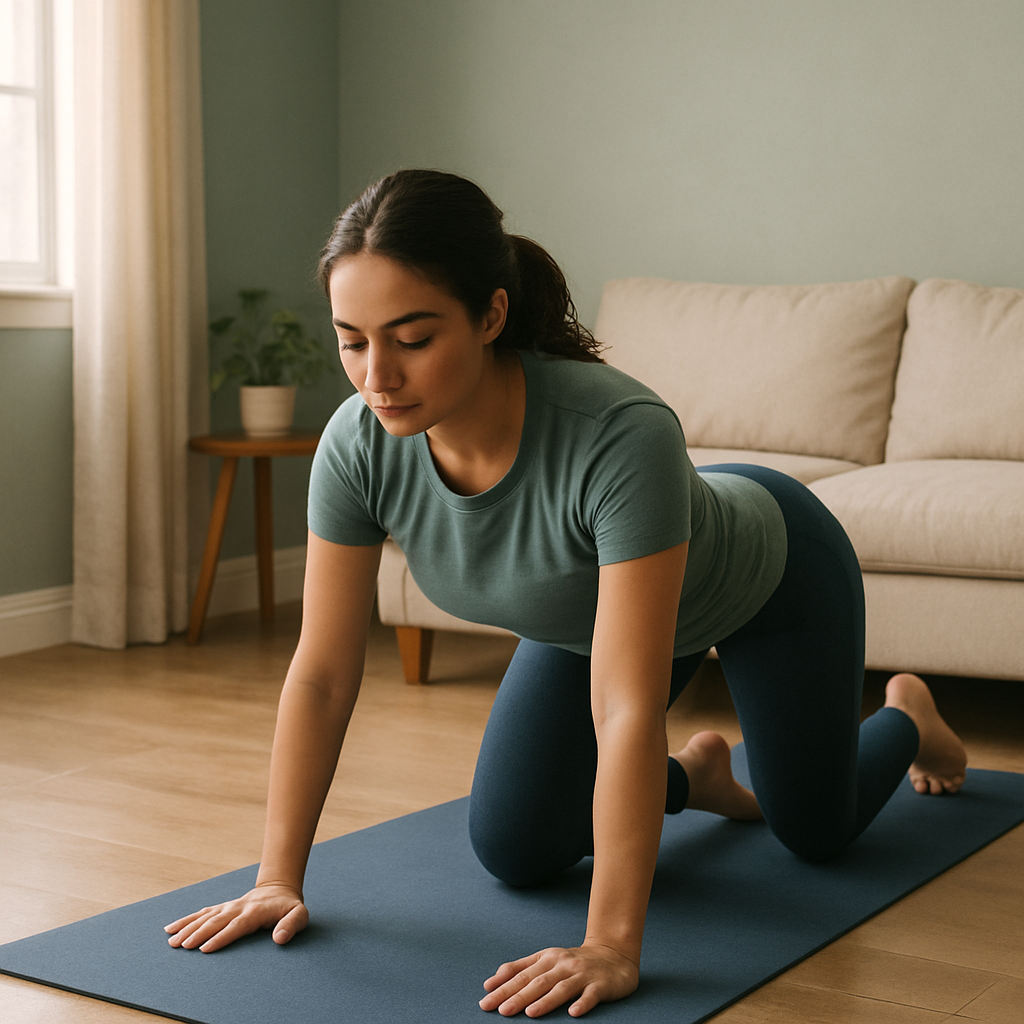
<p>Let’s get practical. Here’s a <strong>sample weekly plan</strong> that illustrates how AI would structure your at-home training. This example is designed for an intermediate level, no equipment, 30-40 minute sessions.</p>
<p><em>Note: a real AI system would adjust these parameters to your specific profile. This is a base model so you can see the structure.</em></p>
<h3>Monday — Upper Body Strength</h3>
<ul> <li><strong>Warm-up (5 min):</strong> Shoulder rotations, arm circles, cat-cow</li> <li><strong>Push-ups (3x10-15):</strong> Adjust the variation— incline for beginners, diamond for advanced</li> <li><strong>Pike push-ups (3x8-12):</strong> Focus on shoulders</li> <li><strong>Chair dips (3x10-15):</strong> Triceps and lower chest</li> <li><strong>Shoulder tap plank (3x12 each side):</strong> Core + stability</li> <li><strong>Superman hold (3x20 sec):</strong> Lower back and posterior chain</li> <li><strong>Cooldown (5 min):</strong> Chest, shoulder, triceps stretches</li> </ul>
<h3>Tuesday — Cardio HIIT</h3>
<ul> <li><strong>Warm-up (5 min):</strong> Marching in place, gentle jumping jacks</li> <li><strong>Circuit (4 rounds, 30 sec work / 15 sec rest):</strong></li> <li>Burpees (or modified burpees)</li> <li>Mountain climbers</li> <li>Squat jumps</li> <li>High knees</li> <li>Skater lunges</li> <li><strong>Rest between rounds:</strong> 60 seconds</li> <li><strong>Cooldown (5 min):</strong> Gentle walk, dynamic stretches</li> </ul>
<h3>Wednesday — Mobility and Core</h3>
<ul> <li><strong>Mobility flow (15 min):</strong> Yoga sequence: down dog → cobra → warrior I → warrior II → triangle</li> <li><strong>Core circuit (3 rounds):</strong></li> <li>Front plank (30-60 sec)</li> <li>Side plank (30 sec each side)</li> <li>Dead bugs (12 each side)</li> <li>Bicycle crunches (20 each side)</li> <li>Hollow body hold (20-30 sec)</li> <li><strong>Deep stretches (10 min):</strong> Hips, hamstrings, spine</li> </ul>
<h3>Thursday — Lower Body Strength</h3>
<ul> <li><strong>Warm-up (5 min):</strong> Air squats, hip rotations</li> <li><strong>Bulgarian split squats (3x10 each leg):</strong> The king of unilateral exercises</li> <li><strong>Glute bridges (3x15):</strong> Single-leg version for more challenge</li> <li><strong>Walking lunges (3x12 each leg):</strong> Coordination + strength</li> <li><strong>Wall sit (3x30-45 sec):</strong> Muscular endurance</li> <li><strong>Calf raises (3x20):</strong> On a step for more range</li> <li><strong>Cooldown (5 min):</strong> Quad, hamstring, hip stretches</li> </ul>
<h3>Friday — Functional Full Body</h3>
<ul> <li><strong>Warm-up (5 min):</strong> Full joint mobility</li> <li><strong>Circuit (3-4 rounds, 45 sec work / 15 sec rest):</strong></li> <li>Squat + imaginary press (simulate weight)</li> <li>Push-ups with rotation</li> <li>Alternating reverse lunges</li> <li>Table rows (or towel in door)</li> <li>Plank to downward dog</li> <li><strong>Cooldown (5 min):</strong> General stretches</li> </ul>
<h3>Saturday — Free activity</h3>
<p>Walk, swim, bike, dance, play with your kids. Whatever gets your body moving in a fun way. AI may suggest activities based on the week’s training volume.</p>
<h3>Sunday — Active rest</h3>
<p>Gentle stretching, a 20-30 minute walk, foam rolling if you have one. <strong>Rest is training</strong>. Your body needs to recover so it can grow.</p>
<h2>How AI tailors this plan for you</h2>
<p>The above plan is a starting point. Here’s where the magic of personalization comes in:</p>
<h3>If you’re a complete beginner</h3>
<p>AI would lower the volume (fewer sets), simplify exercises (push-ups on knees, partial squats), and add more rest days. You’d probably start with 3 training days versus 5, with gradual progression.</p>
<h3>If you have a knee injury</h3>
<p>Say goodbye to squat jumps, lunges with impact, and any exercise that strains the joint. AI would swap in low-impact moves: glute bridges, partial squats, isometric work within safe ranges.</p>
<h3>If you only have 20 minutes</h3>
<p>The system would compress sessions into high-density circuits: less rest, compound movements that hit more muscles per exercise, integrated warm-ups. Every minute counts.</p>
<h3>If your goal is fat loss</h3>
<p>Greater emphasis on HIIT and metabolic circuits, with enough strength work to preserve muscle mass. AI could also coordinate with nutrition data to optimize your calorie deficit.</p>
<h2>AI-powered training tools for home: the current landscape</h2>
<p>The AI-powered fitness ecosystem is booming. Here are the main ways to tap into it in 2026:</p>
<h3>Conversational assistants (ChatGPT, Gemini, Claude)</h3>
<p>You can ask an LLM to design your routine. <strong>Advantage:</strong> flexible, free, customizable by conversation. <strong>Limitation:</strong> according to a study published in <em>Applied Sciences</em> (MDPI, 2025), LLM-generated programs often lack essentials such as individualized health screening, real-time adaptability, and nuanced periodization strategies.</p>
<p>Our advice: use them as a starting point, but not your only coach.</p>
<h3>AI-powered specialist apps</h3>
<p>Apps like <strong>Triwell</strong> are built specifically to holistically integrate AI into your wellness. It’s not just about giving you a list of exercises, but about understanding your context—sleep, nutrition, stress, activity level—to prescribe training that truly works.</p>
<h3>Wearables + AI</h3>
<p>Apple Watch, Oura Ring, Whoop and other devices generate continuous data that powers AI algorithms. Heart rate, heart rate variability (HRV), sleep quality, steps… all that information enables much more precise adjustments than any static questionnaire.</p>
<h2>The 5 principles of effective home training (with or without AI)</h2>
<p>Technology is powerful, but fundamentals remain the same. Any at-home routine should respect these principles:</p>
<h3>1. Progressive overload</h3>
<p>Your body needs increasing stimuli to keep improving. Without weights, you can still progress in several ways:</p>
<ul> <li>Increase repetitions</li> <li>Reduce rest time</li> <li>Use harder variations (regular push-ups → clapping push-ups)</li> <li>Add tempo (lower in 3 seconds, rise in 1)</li> <li>Include isometric holds</li> </ul>
<p>AI is especially good at this: <strong>it automatically calculates when and how to increase difficulty</strong>.</p>
<h3>2. Purposeful variety</h3>
<p>Changing exercises daily isn’t variety, it’s chaos. Effective variety introduces gradual, strategic changes: rotating exercises every 3-4 weeks, alternating stimuli (strength vs. endurance vs. power), and different movement ranges.</p>
<h3>3. Adequate recovery</h3>
<p>Training breaks down muscle fibers. Rest rebuilds them stronger. An AI system monitors signs of fatigue (performance drops, rising resting heart rate) and adjusts workload before you reach overtraining.</p>
<h3>4. Consistency over intensity</h3>
<p>Three sessions a week for a year beats seven sessions a week for a month. AI can help by setting realistic goals and celebrating adherence, not just performance.</p>
<h3>5. Enjoyment</h3>
<p>If you hate your workout, you won’t stick with it. Intelligent systems learn which exercises you prefer and build routines balancing effectiveness with enjoyment. Because <strong>the best workout is the one you do</strong>.</p>
<h2>Common mistakes in home training (and how AI helps prevent them)</h2>
<p>Training without supervision comes with pitfalls. Here are the most frequent mistakes and how technology can help you avoid them:</p>
<ul> <li><strong>Skipping warm-up:</strong> AI includes a mandatory warm-up in every session and adapts it for the day’s workout.</li> <li><strong>Ignoring the lower body:</strong> Algorithms automatically balance volume across muscle groups.</li> <li><strong>Always doing the same thing:</strong> Automated periodization ensures strategic variety.</li> <li><strong>Training with pain:</strong> If you report discomfort, the system modifies or omits risky exercises.</li> <li><strong>Comparing yourself to others:</strong> Your plan is yours. AI doesn’t compare you to anyone, it optimizes for your individual progress.</li> </ul>
<h2>The future: where AI training is headed</h2>
<p>What we have today is just the beginning. The convergence of several technologies promises a future where home training is as effective (or more) as gym training with a coach:</p>
<ul> <li><strong>Computer vision:</strong> Cameras analyze your form in real time and correct posture. Functional prototypes already exist.</li> <li><strong>Environmental sensors:</strong> Smart mats measure weight distribution, force applied, and stability.</li> <li><strong>Digital twins:</strong> An avatar that replicates your body and simulates the effect of different training programs before you try them.</li> <li><strong>Holistic integration:</strong> AI that connects your training with your nutrition, sleep, work stress, and circadian cycles. These are no longer separate silos, but a unified wellness system.</li> </ul>
<p>At Triwell, we’re building exactly that vision: <strong>a holistic wellness companion that understands exercise doesn’t exist in a vacuum</strong>. Your training affects your sleep, your food impacts your workout, your stress affects everything. AI is the tool that can orchestrate all these pieces.</p>
<h2>Start today: your first step</h2>
<p>You don’t have to wait for perfect technology. You can start right now:</p>
<ol> <li><strong>Define your main goal:</strong> Strength? Endurance? Fat loss? General wellness? Pick one.</li> <li><strong>Honestly assess your level:</strong> How many push-ups can you do? How long can you hold a plank? There are no wrong answers.</li> <li><strong>Use AI as an assistant:</strong> Ask an AI assistant to design a plan based on your answers. Be specific about your limitations and preferences.</li> <li><strong>Commit for 3 weeks:</strong> Research shows 21 days is the minimum for a behavior to start becoming a habit.</li> <li><strong>Adjust based on feedback:</strong> After each week, review what worked and what didn’t. A good AI system does this automatically.</li> </ol>
<p>Your body is the only place you have to live your whole life. It deserves a workout plan as unique as you are. And thanks to artificial intelligence, <strong>that personalized plan is no longer a privilege reserved for those who can afford a personal trainer</strong>. It’s within reach for anyone with a smartphone and the will to start.</p>
<p>The best time to start was yesterday. The second best time is now. 💪</p>