 10 min read
Foods rich in magnesium: Benefits and how to add them to your diet
 Equipo TriwellApril 6, 202610 min
There is a mineral involved in more than 300 enzymatic reactions in your body, and yet 79% of the Spanish population consumes it in insufficient amounts. It's called magnesium, and you're probably ignoring it.
Not because you don't want to take care of yourself. But because no one has really explained what it's for, which foods contain it, and how to make sure you're getting enough. That's exactly what we're going to do here.
## What Does Magnesium Do in the Body?
Magnesium is an essential mineral that acts as a cofactor in more than 300 biochemical reactions. That means without it, your body can't perform basic functions like producing energy, synthesizing proteins, or regulating the nervous system.
Here are its main functions:
**Energy and metabolism:** Magnesium is essential for the mitochondria — the "powerhouses" of your cells — to function. Without magnesium, there’s no ATP, and without ATP, there’s no energy. It really is that straightforward and important.
**Nervous and muscular system:** This mineral regulates nerve impulses and muscle contraction. When there's a deficit, muscles don't relax correctly, which explains the nighttime cramps many people suffer from without knowing why.
**Bone health:** About 60% of the body’s magnesium is stored in the bones. It works together with calcium and vitamin D to maintain bone density. It’s not a substitute for calcium, but without magnesium, calcium doesn’t get absorbed properly.
**Stress and sleep regulation:** Magnesium acts on the HPA axis (hypothalamus-pituitary-adrenal), modulating the stress response. Studies published in the Journal of Research in Medical Sciences have observed that magnesium supplementation improves sleep quality, especially in people over 50.
**Blood pressure and cardiovascular health:** Several studies have linked low magnesium levels to a higher risk of hypertension, arrhythmias, and even heart attacks. The World Health Organization recognizes its role in cardiometabolic health.
**Glucose control:** Magnesium improves insulin sensitivity. A review published in Diabetes Care concluded that with each additional 100 mg/day of magnesium in the diet, the risk of developing type 2 diabetes dropped by 15%.
## How Much Magnesium Do You Need Per Day?
The recommended intake varies according to age and sex:
- Adult men (19-30 years): 400 mg/day - Adult men (over 31 years): 420 mg/day - Adult women (19-30 years): 310 mg/day - Adult women (over 31 years): 320 mg/day - Pregnant women: up to 360 mg/day
The worrying data is that, according to the ANIBES study by the Spanish Nutrition Foundation, nearly 8 out of 10 Spaniards consume less than 80% of this amount. And that has real consequences in everyday life.
## Signs You Might Be Deficient in Magnesium
Before you get to a blood test (which, by the way, only measures serum magnesium, not intracellular magnesium), your body sends you signals:
- Frequent muscle cramps, especially at night - Persistent fatigue without any apparent cause - Trouble falling asleep - Irritability or anxiety with no clear reason - Tingling or numbness - Headaches or recurring migraines - Chronic constipation
Do any of these sound familiar? It doesn’t automatically mean you’re deficient, but it’s definitely worth reviewing your diet.
## The Best Magnesium-Rich Foods
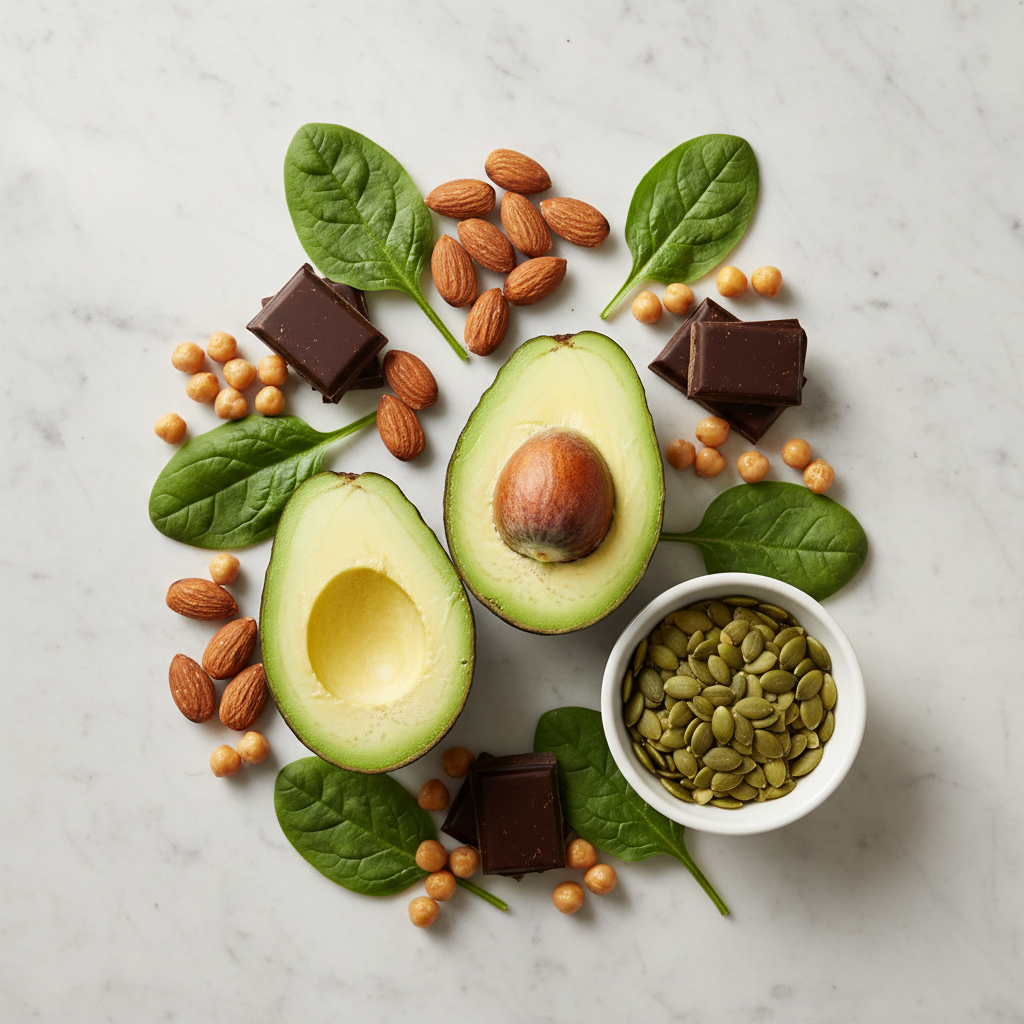
Here’s the practical key. Magnesium is mainly present in plant-based foods, though it’s found in some animal products as well. These are the most notable (content per 100 g edible portion):
**Nuts and seeds:** - Almonds: 250-270 mg - Pumpkin seeds: 550 mg (the food richest in magnesium) - Cashews: 270 mg - Chia seeds: 335 mg - Pistachios and hazelnuts: about 150 mg
**Legumes:** - Chickpeas: 150 mg - White beans: 140 mg - Lentils: 78 mg - Edamame: 65 mg
**Whole grains:** - Raw oats: 177 mg - Buckwheat: 231 mg - Wholegrain bread: 91 mg - Cooked brown rice: 44 mg
**Leafy green vegetables:** - Swiss chard: 76 mg - Cooked spinach: 87 mg - Arugula: 47 mg - Kale: 35 mg
**Dark chocolate and cocoa:** - Unsweetened cocoa powder: 499 mg - Dark chocolate over 70%: 200-230 mg
**Fish and shellfish:** - Shrimp and prawns: 76 mg - Canned sardines: 50 mg - Mackerel: 45 mg - Clams and cockles: 50 mg
**Fruits:** - Avocado (half a piece): about 30 mg - Medium banana: about 32 mg - Dried figs: 68 mg
The interesting thing about this list is that many of these foods should already be in your kitchen. It’s not about buying expensive exotic superfoods, but reorganizing what you already have.
## What Reduces Magnesium Absorption
Knowing magnesium-rich foods isn't enough if you don’t know what interferes with its absorption. These are the main inhibitors:
**Alcohol:** Significantly increases urinary excretion of magnesium. Regular alcohol consumption can empty your magnesium stores without you noticing.
**Excess coffee:** The diuretic effect of caffeine also flushes out magnesium in the urine. A couple of coffees a day isn’t a problem, but five or six can take their toll.
**Chronic stress:** Maybe the most underrated. Cortisol raises magnesium excretion, creating a vicious cycle: stress depletes magnesium, and magnesium deficiency worsens the stress response.
**Diuretics and some medications:** Proton pump inhibitors (omeprazole and similar), thiazide diuretics, and some antibiotics reduce absorption or increase excretion.
**Diets high in refined sugar:** Processing glucose uses up magnesium, so high-sugar diets can cause an accumulated deficit.
## How to Add More Magnesium to Your Diet Without Complicating Things
The theory is great, but practice is what matters. Here are some concrete ideas:
**Oat-based breakfast.** A bowl of porridge with a tablespoon of chia seeds and a banana can provide over 150 mg of magnesium at once. Add a handful of almonds and you’ll be close to 50% of your daily needs before noon.
**Legumes 3-4 times a week.** Not as a minor side, but as the main event. A plate of chickpeas with spinach and garlic is a magnesium, iron, and fiber powerhouse.
**One square of dark chocolate per day.** Yes, it’s fully justified nutritionally. Choose one with at least 70% cocoa and enjoy it guilt-free.
**Swap white rice for brown rice or quinoa.** Brown rice has twice the magnesium of white, and quinoa has even more. The flavor is different, but your body will thank you.
**Smart snacks.** Swap cookies for a handful of almonds or pistachios. Magnesium from nuts is well absorbed and they’re much more filling.
**Leafy greens at every meal.** They don’t have to be boring salads. Sautéed spinach with garlic, chard with lemon, or kale in a stir-fry are quick and delicious options.
## Should You Supplement?
Let’s be honest: magnesium supplements work and are backed by evidence, but they should not be your first step. If your diet is balanced and rich in the foods listed above, you probably won’t need them.
However, if you live a highly stressful life, regularly drink alcohol, take omeprazole long-term, or have any of the symptoms mentioned earlier, consulting a healthcare professional about supplementation might make sense.
The most bioavailable forms of magnesium are bisglycinate and malate. Magnesium oxide, which is the cheapest and most common, has very low bioavailability (less than 4%).
The usual supplementation dose is between 200 and 400 mg/day, always taken away from main meals and preferably at night (it promotes better sleep).
## A Mineral That Deserves More Attention
Magnesium is one of those nutrients that does a lot behind the scenes. It doesn’t cause dramatic symptoms when it starts running low, but its sustained absence is noticeable: more fatigue, worse sleep, more muscle tension, more irritability.
The good news is that the solution doesn’t require major changes. A diet richer in nuts, legumes, whole grains, and leafy greens can make a real difference in how you feel each day.
Sometimes wellbeing is built like this: not through big gestures, but through small, repeated decisions. A handful of almonds here, a plate of lentils there, a piece of dark chocolate after lunch. Nothing extraordinary, but together, it matters a lot.