 12 min read
Breathing techniques to reduce anxiety
 Equipo TriwellMarch 29, 202612 min
Anxiety Doesn't Announce Itself. It appears in the middle of a meeting, while driving, or at three in the morning when everything is silent. And when it arrives, your breathing is the first thing to go off track: it becomes short, shallow, erratic. What’s curious is that this very mechanism that gets thrown off can be the most powerful tool to regain control.
I’ve spent years exploring breathing techniques, both as a personal resource and out of interest in the scientific evidence behind them. What follows isn’t a generic list: it’s a practical guide with seven methods that work, explained with the science behind them and clear instructions on when to use each one.
## Why Breathing Controls Anxiety: The Real Science
When you feel anxious, your sympathetic nervous system kicks in with a “fight or flight” response. Your heart races, your muscles tense, and your breathing becomes fast and shallow. This cycle feeds on itself: rapid breathing signals your brain that there’s danger, which produces more anxiety.
Conscious breathing breaks this cycle by activating the parasympathetic nervous system, specifically via the vagus nerve. A study published in *Frontiers in Human Neuroscience* (2018) showed that slow breathing techniques (less than 6 breaths per minute) significantly increase heart rate variability (HRV), a direct marker of emotional regulation.
In simple terms: when you exhale longer than you inhale, you’re telling your nervous system you’re safe. And your body responds.
## 1. Diaphragmatic Breathing: The Foundation of Everything
Before trying any advanced technique, you need to master this one. Most people breathe with their chest, which is inefficient and can worsen anxiety.
**How to do it:**
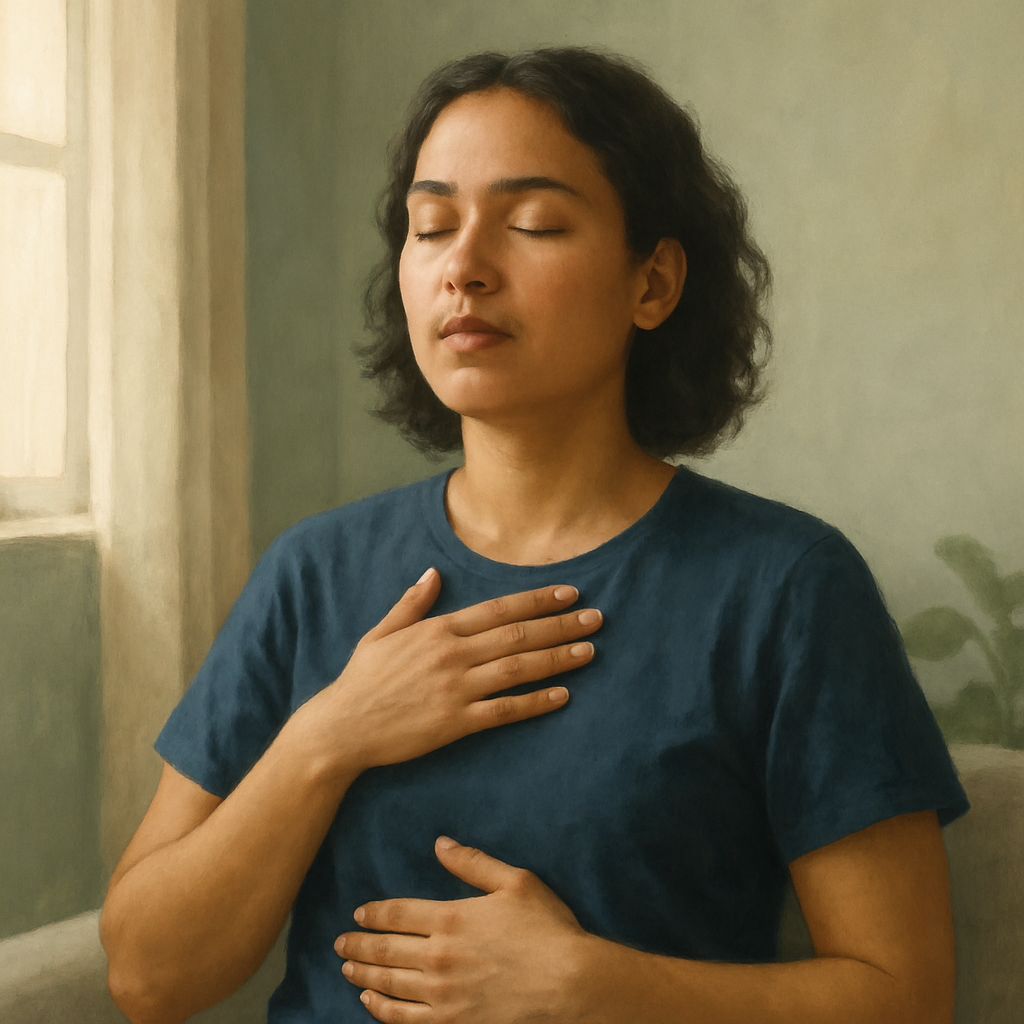
- Sit or lie down comfortably - Place one hand on your chest and the other on your abdomen - Inhale through your nose for 4 seconds, making sure only the hand on your abdomen moves - Exhale through your mouth for 6 seconds, noticing how the abdomen contracts - Repeat for 5-10 minutes
**When to use it:** As a daily maintenance practice. Ideal in the morning or before sleep. The American Psychological Association recommends at least 10 minutes daily to notice sustained changes in baseline anxiety levels.
**My experience:** The first few times are hard because we’re so used to chest breathing that the diaphragm feels rusty. Give it two or three days of consistent practice and it becomes natural.
## 2. 4-7-8 Technique: The Natural Tranquilizer
Developed by Dr. Andrew Weil, based on the yogic practice of pranayama. It’s probably the most cited technique in clinical anxiety research.
**How to do it:**
- Place the tip of your tongue behind your upper front teeth - Inhale through your nose for a count of 4 - Hold your breath for a count of 7 - Exhale completely through your mouth with a gentle noise, counting to 8 - Repeat for 4 cycles (no more at first)
**When to use it:** Before sleep, during a moderate anxiety attack, or when you need to calm down quickly without anyone noticing. The prolonged hold and extended exhale force direct parasympathetic activation.
**Important tip:** Dr. Weil recommends no more than 4 consecutive cycles during the first month. Your body needs to adapt to the 7-second hold, which may cause slight dizziness at first.
## 3. Box Breathing: The Navy SEALs’ Favorite
It’s no coincidence that the Navy SEALs’ training program includes this technique. When you need to keep a cool head under extreme pressure, box breathing is your best ally.
**How to do it:**
- Inhale for 4 seconds - Hold for 4 seconds - Exhale for 4 seconds - Keep your lungs empty for 4 seconds - Repeat for 4-8 cycles
**When to use it:** Before a presentation, exam, difficult conversation, or any situation where you need mental clarity without losing alertness. Unlike 4-7-8 which deeply relaxes you, box breathing centers you without making you drowsy.
**Evidence:** A 2022 study in the *Journal of Clinical Medicine* found that 5 minutes of box breathing significantly reduced salivary cortisol levels compared to the control group.
## 4. Nadi Shodhana Breathing: Nasal Balance
Also known as alternate nostril breathing, it comes from traditional yoga and has a surprisingly potent effect on emotional balance.
**How to do it:**
- Sit with your back straight - With your right thumb, close your right nostril - Inhale through the left nostril for 4 seconds - Close both nostrils and hold for 2 seconds - Release the right nostril and exhale through it for 4 seconds - Inhale through the right nostril for 4 seconds - Close both and hold for 2 seconds - Release the left nostril and exhale through it for 4 seconds - This is one full cycle. Repeat for 5-10 cycles
**When to use it:** When anxiety comes with racing thoughts or mental scatter. Alternating nostrils requires so much concentration it works as an active meditation.
**The science behind it:** Research in the *International Journal of Yoga* has shown this technique reduces both systolic blood pressure and resting heart rate after just 4 weeks of regular practice.
## 5. Resonant Breathing: The Optimal Frequency
This one fascinates me most for its scientific foundation. It’s based on finding the breathing rate that maximizes your HRV, which for most people is between 4.5 and 6.5 breaths per minute.
**How to do it:**
- Inhale for 5 seconds - Exhale for 5 seconds - No pauses between inhale and exhale - Keep a fluid, steady rhythm for 10-20 minutes
**When to use it:** As a formal training practice. Not for emergencies, but for building resilience. Think of it as a gym session for your nervous system.
**Key fact:** Stephen Porges, creator of the Polyvagal Theory, has described that regular resonant breathing practice can modify your baseline vagal tone—that is, your capacity for emotional regulation improves even when you’re not practicing.
## 6. Physiological Sigh: The 30-Second Reset
Discovered (or rather, rediscovered) by Stanford neuroscientist Andrew Huberman, this is the fastest known method for reducing sympathetic nervous system activation.
**How to do it:**
- Take a double inhale through your nose: a deep first breath immediately followed by a shorter one (like a reversed sob) - Exhale slowly through your mouth until your lungs are completely empty - Repeat 1-3 times
**When to use it:** During a panic attack, acute anxiety crisis, or when you need to calm down in less than a minute. It’s as close to a reset button as your nervous system gets.
**Why it works:** The double inhale maximizes reinflation of the pulmonary alveoli (the small air sacs in the lungs that partially collapse during shallow anxiety breathing). This optimizes CO2 exchange, and the prolonged exhale directly activates the vagus nerve.
**Stanford Study 2023:** A controlled trial published in *Cell Reports Medicine* compared physiological sighs to mindfulness meditation, box breathing, and controlled hyperventilation. The physiological sigh was the only technique to significantly improve both mood and HRV with just 5 minutes daily.
## 7. 5-2-7 Breathing: For Nighttime Anxiety
Less well-known but particularly effective for those nights when anxiety keeps you from sleeping.
**How to do it:**
- Inhale gently through your nose for 5 seconds - Hold softly for 2 seconds - Exhale through your nose (not your mouth) for 7 seconds - Repeat until you feel sleepy
**When to use it:** Exclusively before bed or if you wake up with anxiety in the middle of the night. Nasal exhale instead of mouth exhale is key: it keeps arousal lower than mouth breathing, which is more sleep-inducing.
## Quick Guide: Which Technique to Use for Your Situation
Not all techniques are good for the same thing. Here’s a handy reference:
**Panic attack or acute anxiety:** Physiological sigh (technique 6). It’s the quickest and you don’t need to be anywhere special.
**Anxiety before an event (exam, presentation, interview):** Box breathing (technique 3). Centers you without over-relaxing.
**Generalized daytime anxiety:** 4-7-8 technique (technique 2). Four cycles then back to what you were doing.
**Racing thoughts or scattered mind:** Nadi Shodhana (technique 4). The required focus breaks the rumination cycle.
**Insomnia caused by anxiety:** 5-2-7 breathing (technique 7), lying in bed with eyes closed.
**Daily preventive practice:** Resonant (technique 5) or diaphragmatic breathing (technique 1), for 10-20 minutes.
## Common Mistakes That Reduce Effectiveness
After years of practicing and recommending these techniques, here are the most frequent errors I see:
**Forcing the breath.** If you feel short of breath or dizzy, you’re being too aggressive with the timing. Start with shorter intervals and gradually increase them.
**Expecting immediate results from the first session.** Emergency techniques (physiological sigh, 4-7-8) do work instantly. But maintenance methods (resonant, diaphragmatic) need at least 2-3 weeks of consistent practice for measurable changes.
**Only practicing when you’re anxious.** It’s like trying to learn to swim when you’re drowning. Practice when you’re calm so the technique becomes automatic when you need it.
**Ignoring posture.** A slouched back compresses the diaphragm and limits abdominal breathing. If you’re sitting, keep your back straight but not rigid. If lying down, place a pillow under your knees to relieve lower back tension.
## When Breathing Isn’t Enough
Let’s be honest: breathing techniques are extraordinary tools, but they’re not a substitute for professional treatment. If you experience frequent panic attacks, anxiety that interferes with your daily life, or symptoms that don’t improve after several weeks of consistent practice, consult a mental health professional.
Breathing is a fantastic complement to cognitive-behavioral therapy, medication when necessary, and other therapeutic approaches. Not a replacement.
## Start Today, But Start Small
My recommendation: choose a maintenance technique (diaphragmatic or resonant) and practice for 5 minutes a day for a week. Just that. Then learn the physiological sigh for emergencies. With those two tools, you cover 80% of situations.
Anxiety is part of the human experience, not an enemy to eliminate. But when it overflows, having concrete, practiced tools makes the difference between being swept away by the current and knowing how to swim.