 11 min read
Breathing exercises to reduce stress at work
 Equipo TriwellFebruary 24, 202611 min
Work stress is not just a passing annoyance. According to the World Health Organization, it affects nearly 60% of workers in industrialized countries and has become one of the main risk factors for cardiovascular disease, sleep disorders, and mental health issues. The worst part is that many of us normalize it, as if having a tight chest and clenched jaw were simply “part of the job.”
But there’s a free, silent tool you can use without even getting out of your chair: conscious breathing.
I’m not talking about motivational quotes or vague advice like “just relax.” I mean concrete techniques, backed by scientific studies, that act directly on your nervous system to lower cortisol (the stress hormone) and activate your body’s calming response.
An analysis of 58 studies published in the journal Psychoneuroendocrinology in 2024 concluded that relaxation and mindfulness techniques—including controlled breathing—were more effective than talk therapy for reducing cortisol levels. And data from the National Center for Complementary and Integrative Health (NCCIH) confirms that slow diaphragmatic breathing can moderately lower blood pressure and reduce blood cortisol.
Let’s get to the point.
**Why Breathing Works Against Stress (Science in a Nutshell)**
When you’re stressed, your sympathetic nervous system activates: racing heart, shallow breathing, tense muscles. That’s the well-known “fight or flight” response. The problem is that in the office there’s no lion to run from, but your body reacts as if there were.
Deep, controlled breathing activates the vagus nerve, which acts like the emergency brake for your nervous system. It stimulates the parasympathetic system—the “rest and digest” mode—and tells your brain there’s no real danger. The result: your heart rate drops, muscles relax, cortisol decreases, and you can think clearly again.
It’s not magic. It’s basic physiology. And it works within minutes.
**7 Breathing Techniques You Can Do at Your Desk**
These techniques are listed from simplest to most advanced. If you’ve never practiced conscious breathing, start with the first and move on as you get comfortable.
**1. Diaphragmatic Breathing (The Foundation of All)**
This is the fundamental technique. Most of us breathe from the chest, in a shallow way. Here, the goal is to draw air into the abdomen.
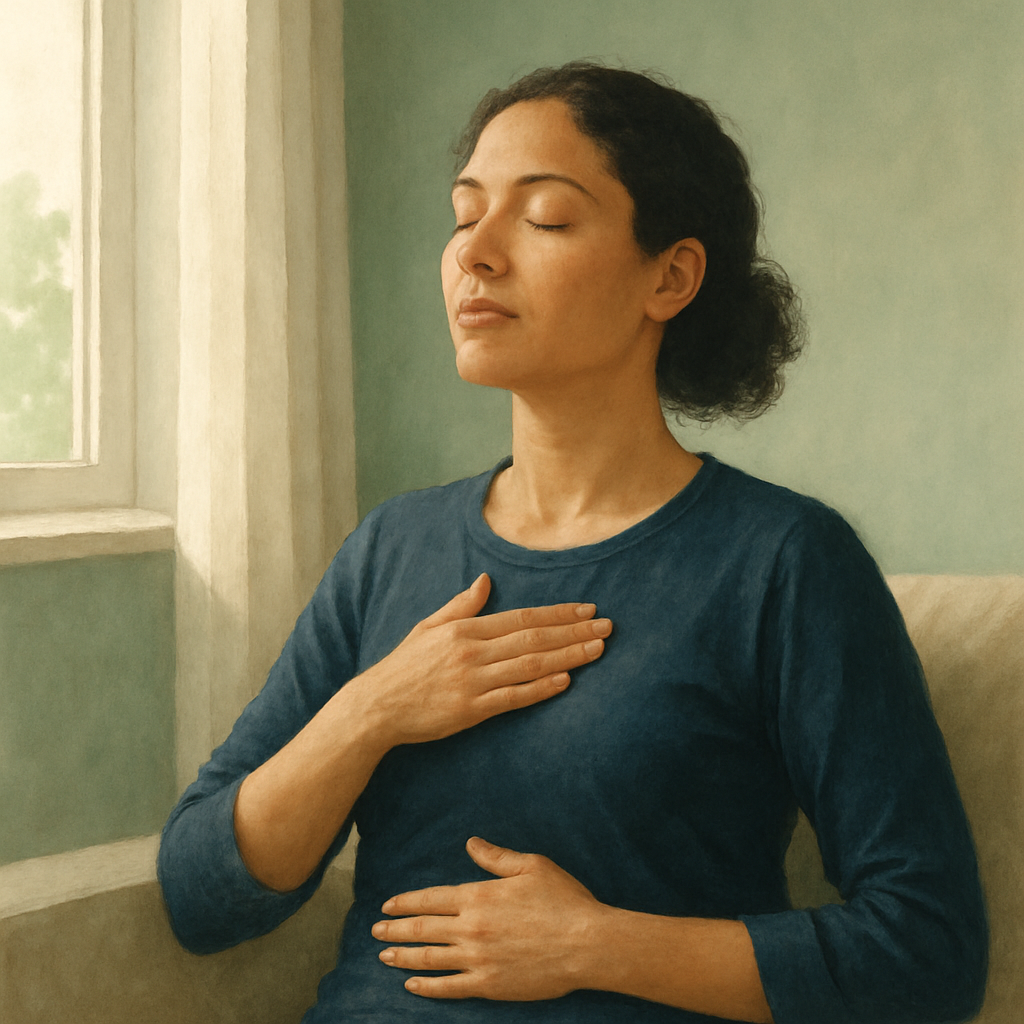
How to do it: - Sit up straight and place one hand on your chest and the other on your abdomen. - Inhale through your nose for 4 seconds. Your abdominal hand should rise; the chest hand should barely move. - Exhale slowly through your mouth for 6 seconds. - Repeat for 5-10 cycles.
When to use it: As a warm-up before any other technique, or whenever you notice you’re breathing rapidly.
A detail many articles don’t mention: if at first it’s hard to “inflate” your abdomen, don’t force it. Simply focus on making your exhalation longer than your inhalation. That alone already activates the vagus nerve.
**2. 4-7-8 Technique (The Natural Tranquilizer)**
Developed by Dr. Andrew Weil, this technique is especially useful for moments of acute anxiety, like before a presentation or after a tense meeting.
How to do it: - Inhale silently through your nose while counting to 4. - Hold your breath for a count of 7. - Exhale completely through your mouth (making a slight sound) for a count of 8. - Repeat 4 cycles.
Why it works so well: the prolonged breath retention and extended exhalation force your nervous system to slow down. It’s almost impossible to stay in high-alert mode when you exhale for 8 seconds.
My personal recommendation: do this in the bathroom if you don’t want coworkers looking at you funny. It works just as well.
**3. Box Breathing**
This technique is used by Navy SEALs before high-risk operations. If it works for them under extreme pressure, it’ll also work for you in the office.
How to do it: - Inhale for 4 seconds. - Hold for 4 seconds. - Exhale for 4 seconds. - Hold with lungs empty for 4 seconds. - Repeat for 4-6 cycles.
It’s very useful when you need quick focus. For example, before a big decision or when you’ve been staring at a screen for hours and your brain feels “foggy.”
**4. Alternate Nostril Breathing (Nadi Shodhana)**
This comes from yoga and might sound exotic, but it’s surprisingly effective at balancing activity between the two brain hemispheres.
How to do it: - Block your right nostril with your right thumb. - Inhale through the left nostril for 4 seconds. - Block the left nostril with your right ring finger. - Exhale through the right nostril for 4 seconds. - Inhale through the right nostril for 4 seconds. - Block the right nostril and exhale through the left. - That’s one cycle. Repeat 5-10 times.
A study published in the International Journal of Yoga found that this technique significantly reduces stress markers and improves heart rate variability, a key indicator of stress resilience.
**5. Breathing with Prolonged Exhalation**
If you could only practice one technique, let it be this one. It’s the simplest and gives the highest benefit-to-effort ratio.
How to do it: - Inhale for 3 seconds. - Exhale for 6 seconds (double). - No pauses between cycles. - Continue for 2-3 minutes.
The key is that the prolonged exhalation is what truly activates the parasympathetic system. Many people obsess over deep inhales, but the secret is in the long exhale.
**6. Breathing with Progressive Muscle Relaxation**
This combines breathing with a rapid body scan. Ideal for the end of the workday or after an especially tough day.
How to do it: - Inhale deeply and tense your feet tightly for 5 seconds. - Exhale and release all tension quickly. - Repeat with calves, thighs, abdomen, hands, shoulders, and face. - Each muscle group: one tense inhale, one relaxing exhale.
What makes it special is that we’re often unaware of the tension we’re holding until we actively release it. That contrast between tension and relaxation teaches your body what true relaxation feels like.
**7. Coherent Breathing (5.5 Breaths Per Minute)**
This is the technique most backed by recent research. It involves breathing at a rate of about 5.5 breaths per minute, which synchronizes your heart rate with breathing and maximizes heart rate variability.
How to do it: - Inhale for 5.5 seconds. - Exhale for 5.5 seconds. - No pauses. - Practice for 5-20 minutes.
You can use an app like Breathe or a simple metronome to keep the rhythm. With practice, your body internalizes this pattern and you start to breathe this way naturally during calm moments.
**How to Integrate These Techniques Into Your Workday**
Let’s be realistic: no one’s going to do 20 minutes of breathing in the middle of a chaotic workday. But 2-3 minutes, three times a day, is perfectly doable and already makes a noticeable difference.
A practical routine you can follow:
- When you arrive at work: 5 cycles of diaphragmatic breathing to start centered. - Before important meetings: 4 cycles of 4-7-8 technique. - After lunch: 3 minutes of coherent breathing. - When you feel overwhelmed: Box Breathing, 4-6 cycles. - End of the day: Breathing with progressive muscle relaxation.
The trick is associating each technique with a specific moment of the day. That way it becomes a habit without needing willpower.
**Common Mistakes to Avoid**
After recommending these techniques to many people, I’ve seen the same mistakes repeatedly:
Forcing your breath. If you feel dizzy or uncomfortable, you’re pushing too hard. Conscious breathing should never be uncomfortable. Shorten the times and gradually increase.
Expecting immediate results and quitting. The first few times you might not notice much. Real benefits come with regular practice, just like physical exercise. Give it at least two weeks.
Only doing it when you’re already at your limit. It’s much more effective as prevention than reaction. If you wait until you’re completely overwhelmed, any technique will be harder.
Thinking it’s enough on its own. Breathing is a powerful tool, but it doesn’t replace good sleep, exercise, setting boundaries at work, or seeking professional help if you need it.
**What Other Articles Don’t Tell You**
Most articles on this topic just give you the techniques and that’s it. But there’s something fundamental that often gets left out: conscious breathing works better when you identify your early stress signals.
Are you clenching your jaw? Raising your shoulders without realizing? Knot in your stomach? Those are your personal alarms. Learn to recognize them and use breathing at that moment, not after you’ve already been accumulating tension for hours.
Another thing that’s rarely mentioned: breathing well throughout the day is more important than sporadic exercises. If you spend 8 hours breathing shallowly from your chest and then do 5 minutes of diaphragmatic breathing, the impact will be limited. Try to check in with your breath several times a day, even if it’s just for 30 seconds each time.
**When to Seek Professional Help**
Conscious breathing is a wonderful tool, but it has its limits. If you’re experiencing constant anxiety that interferes with your daily life, frequent panic attacks, chronic insomnia, or physical symptoms like chest pain or palpitations, speak to a mental health professional. These techniques complement treatment, not replace it.
**Conclusion**
You don’t need a paid meditation app, a mindfulness retreat, or a free hour in your schedule. You need 2-3 minutes, three times a day, and the willingness to pay attention to something you already do automatically: breathe.
Pick a technique, try it for a week, and watch how your relationship with daily stress changes. Your nervous system will thank you.